
What is an AGV System? The Complete Guide to Automated Material Handling Systems in Industry
In the modern industrial world, more and more factories, logistics centers, and manufacturing companies are seeking ways to improve efficiency, reduce costs, and make processes simpler, faster, and safer. One of the most prominent technologies in this field is the AGV system.
So what is an AGV system?
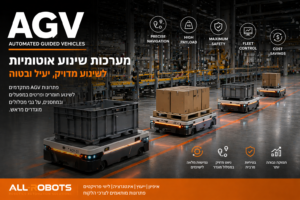
AGV stands for Automated Guided Vehicle—an automated guided vehicle whose function is to transport materials, goods, pallets, components, or products from point to point within a factory, warehouse, or logistics center, automatically and without a driver. AGV systems were developed to perform internal material handling tasks consistently, accurately, and efficiently, and today they constitute an important part of automation processes in industry, logistics, and even in hospitals and other specialized environments.
How Does an AGV System Work?
An AGV system typically operates based on a predefined route. In several applications, the vehicle navigates using wires, magnetic tape, floor markings, QR codes, or other navigation solutions that have been predefined for it. This means that the AGV knows where to depart from, where to arrive, and which route to follow between stations in the factory or warehouse. According to KUKA, classic AGV systems are typically “track-bound,” meaning they are tied to a defined route, and they can detect obstacles—but in most cases will stop in place rather than freely navigate around them like an AMR.
What is an AGV system? It is important to understand that this is not just an automated vehicle, but a complete solution for internal material handling:
The system includes the vehicle itself, navigation means, charging stations, traffic control, safety interfaces, and sometimes also fleet management software that distributes tasks among multiple vehicles simultaneously.
Where Are AGV Systems Implemented?
AGV systems are implemented in a very wide range of industries. The most common applications include:
1. Manufacturing Facilities
in forklifts, improve material flow, and reduce human errors.
2. Warehouses and Logistics Centers
In warehouses, AGV systems are used to transport pallets, carts, goods, and items between receiving, storage, picking, and shipping areas. They help optimize logistics operations and improve work pace throughout the day.
3. Automotive Industry
AMR, primarily due to the need for transporting heavy parts, production continuity, and high precision. ABB, for example, emphasizes the use of AMR in intralogistics processes in industries such as automotive, electronics, and logistics.
4. Electronics, Food, Pharmaceuticals, and Semiconductors
In these environments, there is a need for clean, safe, accurate, and sometimes continuous around-the-clock material handling. Therefore, automated material handling solutions receive a central place there. KUKA mentions the suitability of its solutions for sectors such as electronics, photovoltaics, and semiconductors, and ABB emphasizes use in advanced manufacturing and logistics as well.
5. Hospitals and Medical Environments
In the medical world as well, automated material handling solutions are used to transport equipment, food, waste, and support equipment. Studies mention the use of AGVs in hospitals for internal logistics tasks.
What Are the Advantages of an AGV System?
An AGV system is the combination of operational efficiency, safety, and long-term cost savings.
Among the prominent advantages:
- Automation of repetitive internal material handling
- Reduction of manual labor and forklift use
- Improved material flow in the factory or warehouse
- More consistent and accurate operation
- Reduction of human errors
- Improved safety in areas with high internal traffic
- Ability to operate continuously for many hours
What Is the Difference Between AGV and AMR?
This is one of the most important topics in a blog like this, because many people are searching for what an AGV is, and also trying to understand the difference between it and AMR.
AGV
An AGV is an automated guided vehicle that typically operates based on a predefined route or path. It is very suitable for organized, predictable, and relatively fixed environments. If an obstacle appears, the system will often slow down or stop according to its sensor and safety level.
AMR
AMR is an Autonomous Mobile Robot—an autonomous mobile robot. Unlike an AGV, it does not need to be dependent on a fixed physical route. Modern AMR systems use navigation methods such as SLAM, cameras, LiDAR, sensors, and intelligent software to understand the environment, choose a route, avoid obstacles, and adapt to changes in real time.
So Which Is More Advanced?
In general terms, yes—AMR is considered in most cases to be a more advanced and newer generation compared to classic AGV. In professional literature as well, AMR is described as an evolution of AGV, and quite a few manufacturers present it as a more flexible and intelligent solution for dynamic environments. However, this does not mean that AGV is “less good” in every situation. In factories with fixed routes and repetitive tasks, AGV can still be an excellent, stable, and very cost-effective solution.
When to Choose AGV and When to Choose AMR
If your work environment is relatively stable, with fixed traffic routes, predefined delivery points, and repetitive processes—an AGV system can be an excellent solution.
On the other hand, if there is changing traffic, dynamic loads, frequent changes in work lines, or a desire for higher future flexibility.
In many cases, AMR will be a more suitable solution.
Why Does KUKA Have an Advantage in This Field?
If we are already talking about AGV systems and automated material handling solutions, KUKA has a very interesting advantage, especially for companies that are looking not only at a single vehicle, but at a complete automation system.
1. KUKA Does Not Come Only from the Mobile World—But from the Full Automation World
KUKA is a global automation group that operates in industrial robotics, manufacturing systems, intralogistics, and warehouse automation. The company presents itself as a provider of complete automation solutions “from a single source”—meaning from a single component to a complete system. This is an important advantage when a customer wants to integrate robots, internal material handling, software, integration, and controls under one umbrella.
2. Integration with Swisslog Provides Real Logistics Depth
Swisslog, which has been part of the KUKA Group since 2015, specializes in warehouse automation and logistics. Therefore, KUKA has an advantage not only at the level of the individual robot or AGV/AMR, but also in the broad vision of material flow solutions, warehouses, shipping, storage automation, and software.
3. More Advanced Solutions for the New Generation of Mobile Systems
KUKA currently offers both AGV and AMR platforms, with emphasis on autonomous navigation, simpler integration, No-Code, intelligent fleet management, VDA 5050 compatibility, Wi-Fi and 5G connectivity, and solutions with inductive charging in some models. For example, in the KMP 1500P and KMP 600P, SLAM, QR reading for position accuracy, No-Code capabilities, and 5G support are emphasized; in the KMP 3000P, inductive charging and VDA 5050 compatibility are also emphasized.
4. Suitability for Heavy Loads as Well
KUKA offers not only light robots or small solutions, but also platforms for significant loads. Official examples include platforms of 600 kg, 1.5 tons, and even 3 tons, depending on the model. For heavy industrial facilities, this is an important advantage.
In simple terms:
KUKA’s advantage is not only in the vehicle itself, but in the ability to offer a broader ecosystem of automation, integration, logistics, and software.
What Other Brands Exist in the AGV and AMR Field?
Alongside KUKA, there are several other very well-known players in the automated material handling and industrial mobile world:
- MiR – Mobile Industrial Robots One of the most prominent brands in the AMR world, with a strong emphasis on flexible internal transportation in factories and warehouses.
- OMRON: Offers a wide range of autonomous mobile robots, including series in different weights and fleet management software.
- ABB: A very strong player in robotics and automation, with a line of AMR solutions for intralogistics and industry.
- Toyota / Toyota Material Handling: A very well-known player in the material handling and logistics world, including automated solutions for warehouses and industry.
- In addition, there are also other companies in the market with AGV/AMR solutions according to application, industry, load, and work environment.
Is AGV Still Relevant Today?
Yes, absolutely. Although AMR is usually a newer and more flexible solution, in factories where the process is stable, the routes are clear, and the task is constant and repetitive material handling—AGV can be a strong, reliable and cost-effective solution. On the other hand, those seeking higher flexibility, adaptation to changes, and work in a more dynamic environment will sometimes lean toward AMR.
An AGV system is an automated solution for internal material handling of materials, components, pallets, and products within a factory, warehouse, or logistics center.
It is particularly suitable for repetitive, fixed, and organized processes, and helps improve efficiency, safety, and operational continuity.
In contrast, AMR is the newer and more autonomous generation of mobile robots, with intelligent navigation capability in a changing environment. Therefore, the choice between AGV and AMR depends very much on the process structure, the level of environmental dynamics, the budget, and the company’s automation vision.
When examining a professional solution at a high level, KUKA stands out due to the integration of robotics, automation, software, fleet management, and broad integration capabilities—and that is exactly what many companies are looking for today in the smart industry world.
Short FAQ for SEO
What is an AGV?
An AGV is an automated guided vehicle designed to transport materials or products within a factory, warehouse, or logistics center, typically based on a predefined route.
What is the difference between AGV and AMR?
An AGV typically travels on a fixed or predefined route, while an AMR is capable of navigating independently, changing routes, and avoiding obstacles in a more intelligent manner.
Is AMR more advanced than AGV?
In most cases, yes. AMR is considered a newer and more flexible generation of autonomous material handling systems, although AGV is still very suitable for certain applications.
Where are AGV systems used?
In factories, warehouses, logistics centers, the automotive industry, electronics, hospitals, and other manufacturing environments.
Why is KUKA strong in this field?
Because it integrates robotics, automation, software, fleet management, and broad logistics solutions, including connection to the Swisslog world and advanced integration.