
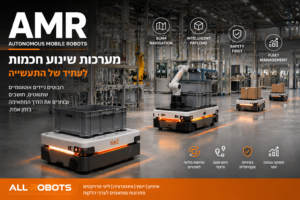
AMR System – What It Is, How It Works, and Why It’s the Future of Automation
Summary
An AMR (Autonomous Mobile Robots) system is an intelligent mobile robot capable of moving autonomously within factories, warehouses, and production environments—without requiring fixed paths.
>Unlike AGV, AMR systems use cameras, LiDAR, and advanced software to navigate in real time, avoid obstacles, and select the optimal route.
The result:
✔ High flexibility
✔ Rapid installation
✔ Long-term cost savings
✔ Adaptation to changing environments
What Is AMR (Autonomous Mobile Robot)?
An AMR system is an autonomous mobile robot that transports materials, products, and components within factories or warehouses—without requiring physical infrastructure such as rails or magnetic tape.
They are based on:
- Advanced sensors (LiDAR, cameras, sensors)
- Navigation and mapping algorithms (SLAM)
- Fleet management software
The system knows how to:
- Map the environment
- Understand its location
- Select the optimal route
- Avoid obstacles in real time
👉 Unlike AGV, AMR does not “move on a track”—it thinks and makes decisions.
Where Are AMR Systems Used?
AMR systems have entered nearly every industrial sector in recent years:
🏭 Industrial Manufacturing
- Transferring parts between stations
- Supplying materials to production lines
- Working alongside employees
📦 Logistics and Warehouses
- Picking
- Goods transfer
- Fulfillment
🏥 Healthcare
- Transporting medical equipment
- Medications
- Samples
🚀 Startups
- Rapid automation solutions
- POC (Proof of Concept)
- Flexible systems without heavy infrastructure investment
Leading AMR Brands
This field is evolving rapidly, with several key players:
- KUKA (Germany)
- Mobile Industrial Robots – MiR (Denmark)
- Locus Robotics (USA)
- Geek+ (China)
- Omron (Japan)
- GreyOrange
- Seegrid
These companies offer:
- Transport robots
- Fleet management systems
- Integration solutions
Advantages of AMR Over AGV
🔥 The Critical Difference – Navigation
AGV:
- Moves on a fixed path (tape, magnet, rail)
- Stops when encountering an obstacle
- Requires physical infrastructure
AMR:
- Moves freely
- Avoids obstacles
- Selects its own route
- Does not require infrastructure modifications
🚀 Key Advantages of AMR
1. Complete Flexibility
Route change?
No need to dismantle infrastructure—simply update the software.
2. Rapid Installation
No need for:
- Excavation
- Path marking
- Complex infrastructure installation
3. Operation in Dynamic Environments
The AMR:
- Detects people
- Detects forklifts
- Avoids obstacles
And does not simply “stop.”
4. Scalability
Robots can be easily added:
- Without infrastructure changes
- Without stopping production
5. Faster ROI
Although the robot price is higher:
👉 The total cost is lower
because there is no infrastructure and no expensive modifications over time
Is AMR Always Better Than AGV?
Not necessarily.
AGV is still relevant when:
- The environment is highly stable
- Routes do not change
- A basic, low-cost solution is desired
However:
👉 In most modern factories
👉 Especially in changing environments
AMR is the preferred solution.
AMR Fleet Management Systems
Advanced systems enable:
- Managing multiple robots simultaneously
- Task optimization
- Integration with ERP / WMS
For example, systems such as KUKA’s enable intelligent fleet control and workflow optimization.
What Is the Common Customer Mistake?
❌ “We’ll buy an AMR and it will work on its own”
The truth:
- Proper specification is required
- Understanding the flow is required
- Proper integration is required
👉 Otherwise—even AMR will not deliver results.
How We at All-Robots Can Help
At All-Robots, we do not just present information—
we provide a complete solution:
✔ Technical system specification
✔ Sales and solution customization (AMR / AGV / hybrid)
✔ Selecting the right suppliers
✔ Project management
✔ Comprehensive commercial solution
👉 We also provide support for startups and complex projects
Frequently Asked Questions (FAQ)
What is the difference between AMR and AGV?
AMR is an autonomous robot that navigates independently, while AGV moves on a predetermined path.
Is AMR safe to work with people?
Yes. It uses advanced sensors to detect people and obstacles and responds in real time.
Does the factory need to be modified to install AMR?
No. This is one of the major advantages—no special infrastructure is required.
How long does it take to implement an AMR system?
Typically much faster than AGV, sometimes only a few weeks.
Is AMR suitable for startups?
Absolutely. It is one of the best solutions for POC and flexible systems.
Summary
AMR systems are among the most important tools in modern automation.
They enable flexibility, cost savings, and adaptability to changes—capabilities that AGV struggles to provide.
For industrial companies seeking to advance to intelligent automation—
AMR is not just a solution, but a new standard.