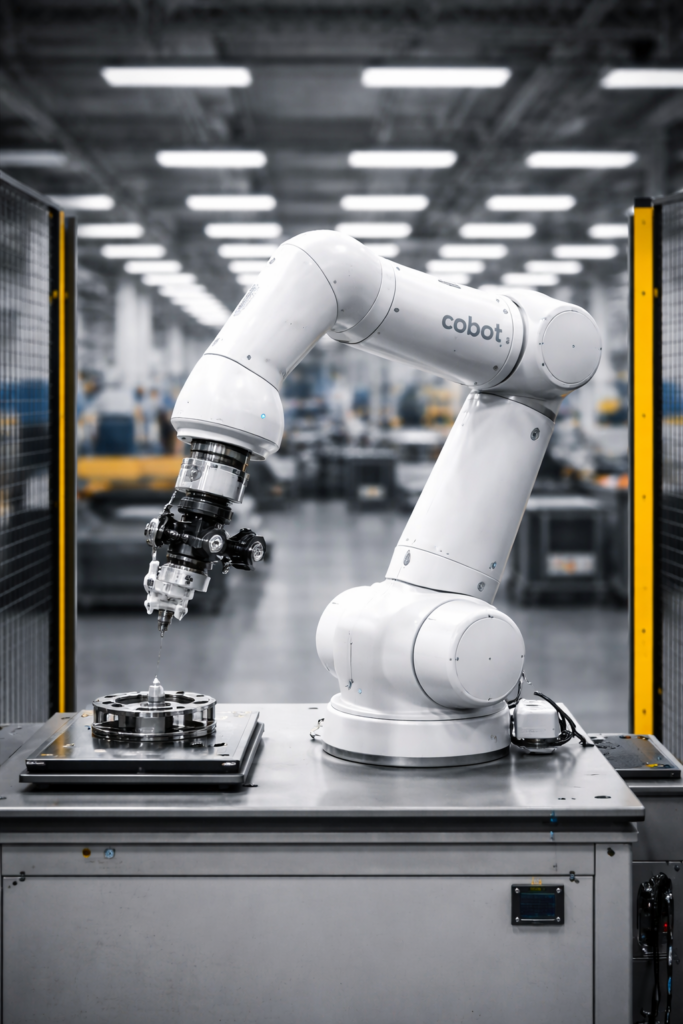
Between Standards, Industrial Reality, and Marketing Promises
Cobots (Collaborative Robots) are sometimes marketed as an “inherently safe” automation solution—one that can be placed next to workers without fencing, without complex planning, and without significant safety measures. In practice, the industrial reality is entirely different. To make the right decision, it is essential to understand what the actual safety standards applicable to cobots are, how they are implemented in the field, and what common mistakes arise from blind reliance on marketing messages.
Cobot ≠ Safety Exemption
An important starting point:
A cobot is not exempt from safety requirements.
It is subject to the same fundamental principles of machinery and robot safety as any other automation system. The difference is not “whether safety is required,” but how it is implemented.
Key Standards for Cobots
The following are the main standards applicable to cobots and human-robot collaborative work:
ISO 10218-1 / ISO 10218-2
The fundamental standard for industrial robots and robot cells. It defines safety requirements for the robot itself and its integration into a system. Cobots are also subject to this standard.
ISO/TS 15066
This is the standard most closely associated with cobots. It defines collaborative operation and establishes clear limits for force, pressure, and speed that a robot may exert in contact with the human body. The standard includes tables of different threshold values for different body parts—from which many of the limitations of cobots arise.
ISO 12100
A general standard for risk assessment in machinery. It requires a systematic risk analysis, regardless of robot type.
ISO 13849
A standard for functional safety of control systems. It defines performance levels (PL) for safety circuits, sensors, scanners, emergency stops, and more—including in cobots.
The implication is clear:
Even a “safe” cobot must undergo a complete risk assessment, meet safety control requirements, and often incorporate additional protective measures.
Field Reality – What Actually Happens in Factories
Contrary to marketing promises, in most industrial cobot deployments, the following are observed:
- Partial or full fencing
- Safety scanners
- Deceleration and separation zones
- Extreme speed limitations
- Frequent robot stops
Why does this happen?
Because once an attempt is made to operate a cobot at a reasonable work pace, or with an end effector that is not entirely “soft,” or near workers in unpredictable motion—the risk analysis almost always leads to the need for additional safety measures.
In practice, a cobot operating “without any fencing” is usually:
- Very slow
- Limited in application
- Far from real production throughput
Marketing Promises – and the Gap from Reality
One of the most common mistakes is making a decision based on presentations and marketing messages:
- “No fencing required”
- “Plug & Play”
- “Safe next to humans in any situation”
These messages ignore the fact that safety is not determined solely by the manufacturer, but by:
- The actual application
- The end effector
- The parts being handled
- The work environment
- Worker movement
- And the required production rate
Once the cobot is introduced into a real industrial environment—the requirements change, and the simple solution becomes far more complex.
Cobots vs. Industrial Robots in Terms of Safety
Paradoxically, in many cases an industrial robot with proper safety planning is a solution that is:
- More clear from a regulatory standpoint
- More operationally stable
- More predictable in performance
- And in the long run, more cost-effective
When humans and robots are separated by appropriate safety measures (fencing, scanners, defined zones), the robot can operate at high speeds, with real throughput, and without the force and speed limitations inherent in cobots.
The Central Mistake: Choosing a Cobot Without Understanding the Technical Need
The problem is not the cobot itself, but the decision to:
- Choose a cobot “because it’s safe”
- Without analyzing the application
- Without understanding standards
- Without considering future throughput
- And without examining industrial alternatives
This is precisely the point where automation turns from a smart investment into a costly mistake.
So When Is a Cobot Appropriate?
Cobots can be the right solution when:
- The applications are simple
- Work rates are low
- Loads are small
- The environment is controlled
- Or for trial and Proof of Concept phases
But even then—only after professional safety planning and not based on general promises.
The Bottom Line
Safety standards for cobots are neither “flexible” nor optional.
They impose limitations, require planning, and sometimes significantly reduce the perceived advantages of the cobot.
Proper automation begins with genuine technical understanding, not a marketing message.
Those who make decisions based on standards, risk analysis, and industrial needs will arrive at a better, safer, and more cost-effective solution over time.