
Summary
Collaborative Robots and industrial robots are two leading solutions in the world of automation. However, the differences between them are highly significant in terms of performance, safety, speed, and long-term cost. In this article, we will understand when a Collaborative Robot is suitable – and why in most cases an industrial robot is the right choice for businesses seeking true efficiency and operational stability.
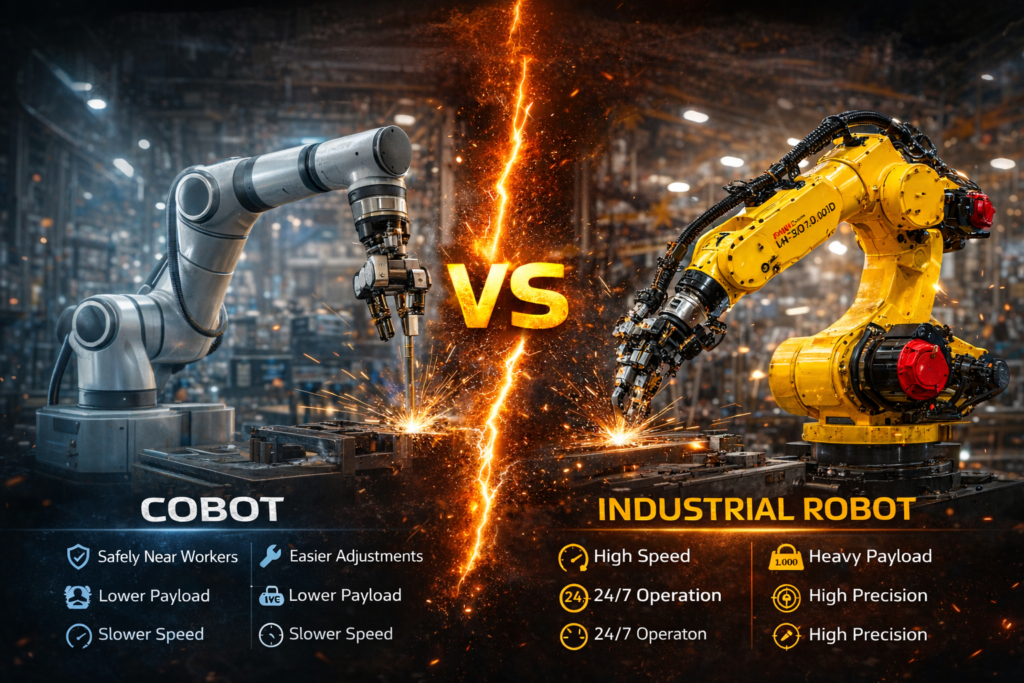
What Is a Collaborative Robot and What Is an Industrial Robot?
Collaborative Robot
A Collaborative Robot is a robot designed to work alongside humans, with built-in safety systems that limit force and speed.
✔ Suitable for delicate tasks
✔ Relatively simple installation
✔ Less need for fencing
Industrial Robot
An industrial robot is a complete automation system designed for continuous, fast, and precise work in production environments.
✔ Very high speed
✔ High precision
✔ 24/7 operation capability
✔ Suitable for heavy loads and complex processes
The Real Difference – Performance, Not Just Safety
⚡ Speed and Efficiency
Collaborative Robots operate at limited speeds to maintain safety.
In contrast, industrial robots operate at significantly higher speeds.
👉 The implication:
Higher throughput = greater profit
🎯 Precision and Stability
Industrial robots deliver high precision over time, even under heavy loads.
👉 In industries such as:
- Electronics
- Automotive
- Packaging
This is critical.
🔄 Continuous Operation
An industrial robot is designed to operate without interruption.
Collaborative Robots?
Sometimes limited in terms of load and intensive work.
Safety and Quality Standards – What You Need to Know
📌 Collaborative Robots – ISO/TS 15066 Standard
Collaborative Robots operate according to the standard:
👉 ISO/TS 15066
The standard defines:
- Force limits
- Pressure limits on the human body
- Safe interaction with workers
👉 Therefore:
Collaborative Robots are limited in performance to meet safety requirements.
📌 Industrial Robots – More Stringent Standards
Industrial robots operate according to:
- 👉 ISO 10218-1
- 👉 ISO 10218-2
These standards address:
✔ Advanced safety systems
✔ Fencing
✔ Sensors
✔ Emergency stop systems
👉 In other words:
Not less safety — but safety at a full industrial level.
When Is a Collaborative Robot Suitable?
✔ Small or medium-scale production
✔ Work alongside employees without separation
✔ Relatively simple processes
✔ When speed is not critical
When Is an Industrial Robot the Right Choice?
✔ Production lines
✔ High throughput
✔ 24/7 operation
✔ Heavy loads
✔ High precision over time
👉 In most cases in real industry – this is the right solution.
The Most Common Mistake
Many businesses think:
👉 “A Collaborative Robot is cheaper = better”
But in practice:
❌ Lower throughput
❌ Longer cycle time
❌ Performance limitations
👉 In the end, it costs more.
Leading Brands in the Market
Industrial Robots:
- KUKA
- ABB
- Fanuc
- Yaskawa
Collaborative Robots:
- Universal Robots
- Hanwha
- Dobot
👉 The difference between them is very noticeable in real projects.
The Bottom Line – Which Is Better?
✔ If you want a simple solution → Collaborative Robot
✔ If you want real results → Industrial Robot
👉 Therefore:
In most serious projects — an industrial robot is the right choice.
FAQ – Frequently Asked Questions
Is a Collaborative Robot Safer?
Not necessarily.
It simply operates at lower speeds to comply with the standard.
Is an Industrial Robot Dangerous?
No.
When operating according to standards (ISO 10218) and safety systems — it is very safe.
Which Is More Cost-Effective?
In most cases:
👉 Industrial robot, due to higher throughput.
Can Both Be Combined?
Yes.
In certain projects, Collaborative Robots and industrial robots are integrated together.
💡 Summary
👉 A Collaborative Robot is a convenient and simple solution
👉 But an industrial robot is a powerful, stable, and profitable solution
Therefore — businesses that truly want to grow choose full industrial automation.
Want to Understand Which Solution Fits Your Business?
Leave your details or send a message — and we will conduct a real assessment for you, including ROI.
FAQ – Frequently Asked Questions
What Is a Universal Robots Collaborative Robot?
A Universal Robots Collaborative Robot is a collaborative robot designed to work alongside humans and perform automated tasks safely and flexibly.
Are Collaborative Robots Safe to Work with Employees?
Yes, in most cases they are designed for collaborative work, but sometimes an additional safety solution is required depending on the application.
What is the difference between a collaborative robot and an industrial robot?
Collaborative Robots are more flexible and safer, but less powerful and fast than industrial robots.
What Applications Are Suitable for a Universal Robots Collaborative Robot?
Assembly, packaging, handling, quality inspection, CNC, and more.
Can Complex Projects Be Executed with a Collaborative Robot?
Yes. With proper planning and professional integration, even very complex projects can be executed.